

TLDR
- Wadoozie is a narrative-driven Ethereum memecoin launching May 27, 2026, with the ticker $WADZ and a 0% buy/sell tax
- 2 billion tokens were minted at genesis, with just under 1 billion burned at launch, leaving an effective supply of 1,000,000,001
- 75% of supply sits in a DAO-governed, locked liquidity pool paired with ETH — no individual or team wallet can move it
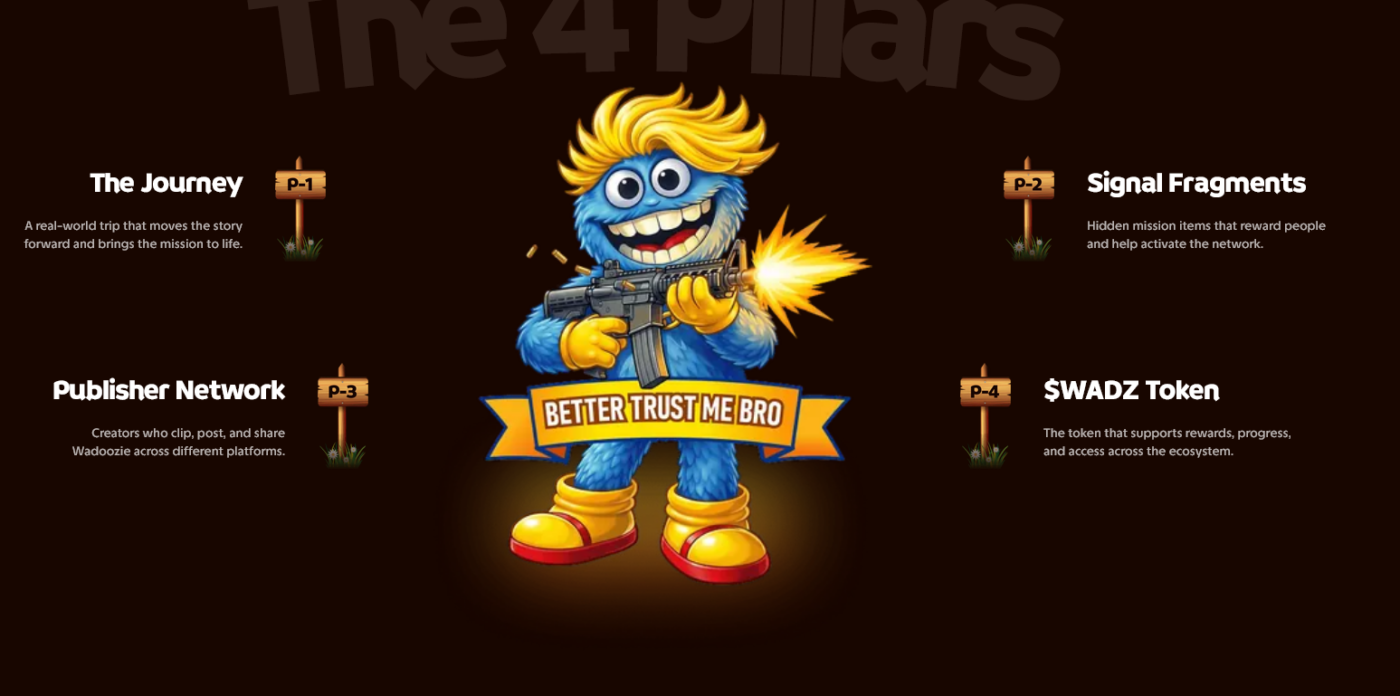
- A physical 48-state U.S. tour activates “nodes,” with 576 hidden Signal Fragments redeemable for $WADZ tokens across four prize tiers
- The team’s 3% allocation is fully locked for 12 months, and the smart contract is renounced post-launch with a CertiK audit published at launch
A new Ethereum memecoin is launching on May 27, 2026, and it comes with a twist: the story is the product, and the token coordinates it.
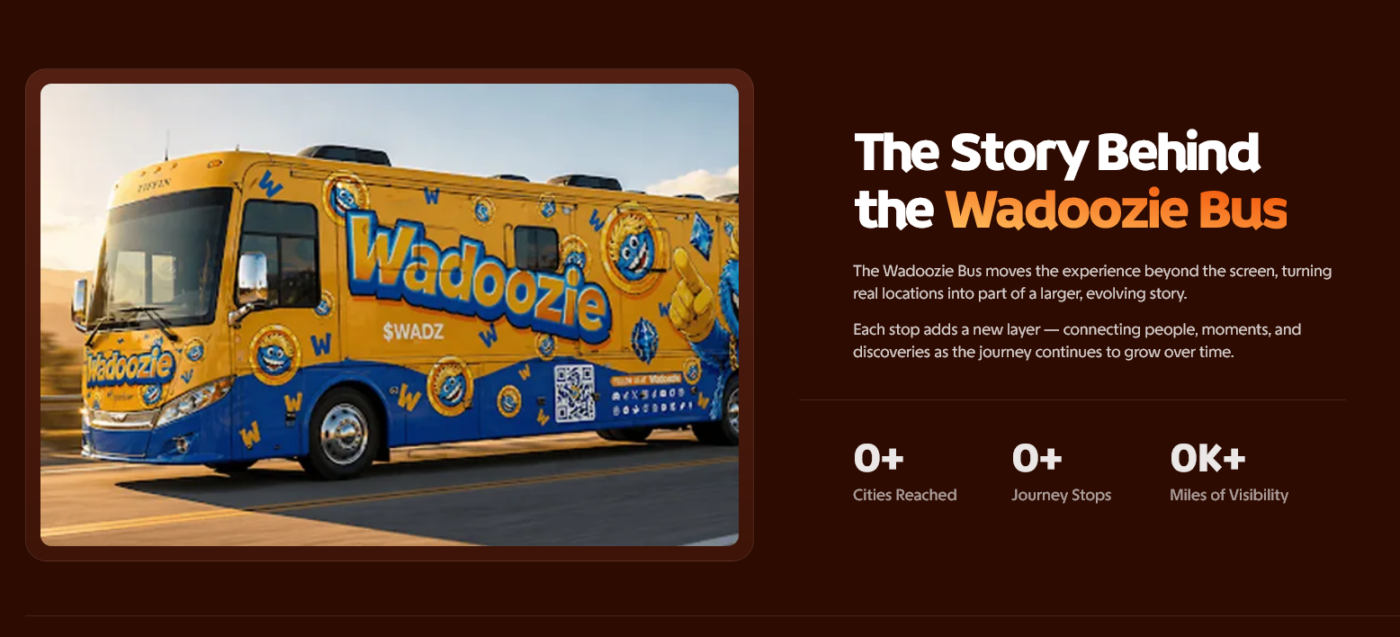
Wadoozie, trading as $WADZ, is described in its litepaper as a “narrative-driven, on-chain attention network.” The project centers on a character — Wadoozie — who travels across all 48 contiguous U.S. states by tour bus, activating what the project calls “nodes” at each stop and dropping hidden token rewards called Signal Fragments for the community to find.
The token is an ERC-20 on Ethereum. It carries no buy or sell tax. The contract is renounced at launch, and a CertiK audit report will be published at launch on wadoozie.com.
The Token Structure
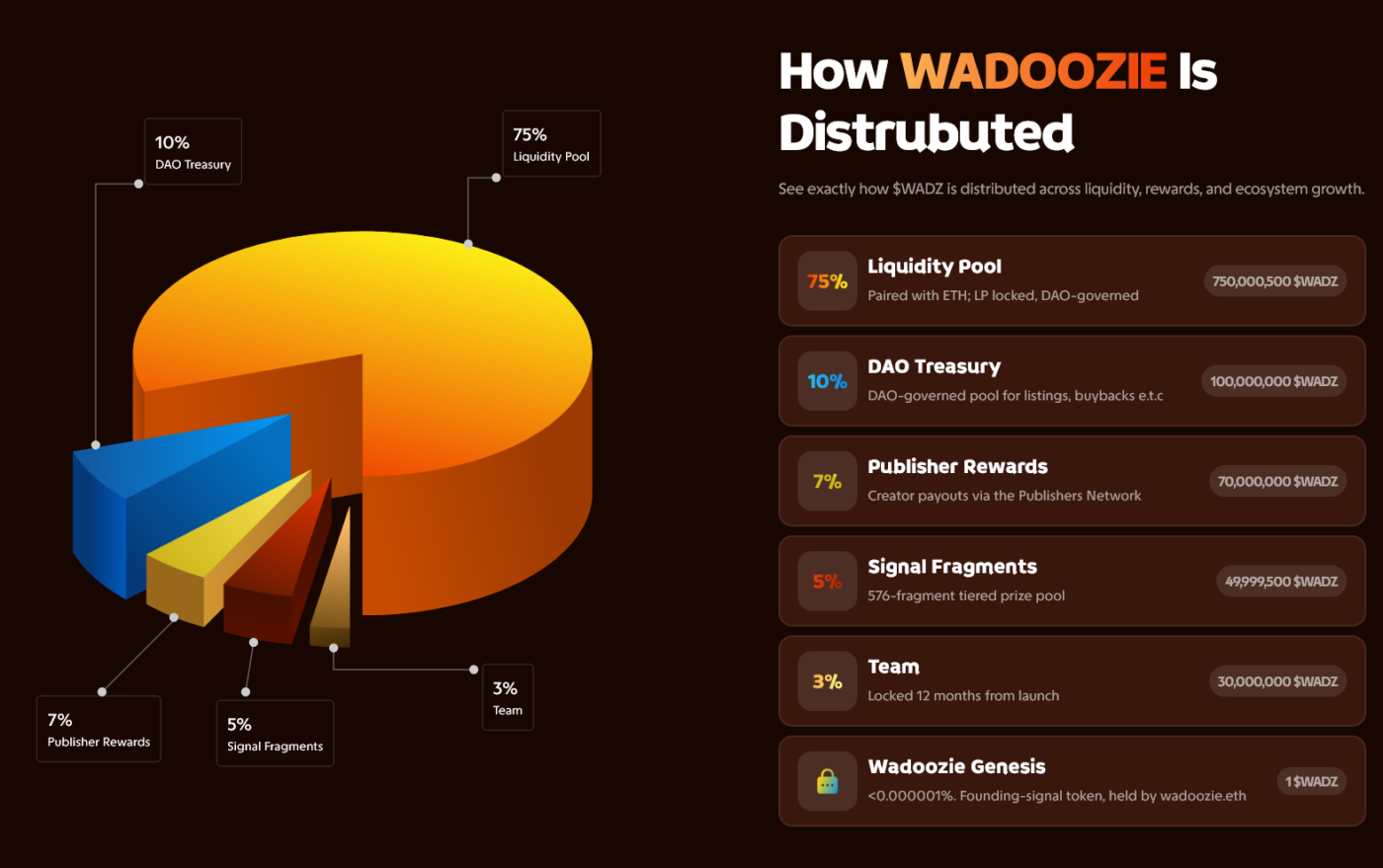
Two billion $WADZ tokens were minted at genesis. At launch, 999,999,999 were burned, leaving an effective circulating supply of 1,000,000,001 tokens.
The project uses a simple price formula: price equals market cap divided by one billion. A $100 position at launch, which is priced at $0.0000625, maps to 1,600,000 tokens. At a $1 billion market cap, that same position would be worth $1,600,000.
Of the effective supply, 75% — or 750,000,500 tokens — goes directly into a liquidity pool paired with ETH. That LP is locked and governed by a DAO, meaning no single wallet, including those of the founding team, can move it without a community vote passing on-chain.
Ten percent sits in a treasury controlled by a multi-sig wallet under DAO governance. Every treasury spend — whether for exchange listings, marketing, or token buybacks — requires an on-chain proposal to pass first.
Seven percent, totalling 70,000,000 tokens, is reserved for creator payouts through the Publishers Network. Five percent funds the 576-fragment Signal Fragment prize pool. The team holds 3%, fully locked for 12 months from launch with no on-chain liquidity during that period.
The 48-State Tour
The physical component of Wadoozie sets it apart from most token projects. A tour bus travels a published route across 48 U.S. states, structured into eight narrative Acts. The tour opens in Austin, Texas, and closes in New Orleans, Louisiana.
Each Act groups a run of states into a single story beat. Act I covers the West Coast landing from Texas through California. Act II moves through Las Vegas and the Mountain West. Act IV, called the Heartland Turn, closes in Chicago. Act VII opens in New York City for a ten-day Flagship event, and Act VIII concludes with a return to New Orleans.
When the bus arrives in a state, that node “activates.” The state’s entry on the mission map switches from dormant to live. Seven physical Signal Fragments enter the field for that state — four Common, one Uncommon, one Rare, and one Legendary.
How Signal Fragments Work
Every state gets the same fragment allocation. No state is favored over another, and every state is guaranteed at least one Tier 4 Legendary prize.
There are 576 fragments in total, split across four rarity tiers. Tier 1 Common fragments number 300 and pay out 15,375 tokens each. Tier 2 Uncommon totals 144 fragments at 46,125 tokens each. Tier 3 Rare totals 72 fragments at 153,750 tokens each. Tier 4 Legendary totals 60 fragments at 461,250 tokens each.
Of the 576 fragments, 336 are hidden across the 48 physical states, seven per state. The remaining 240 live in an online pool released through daily blog posts on wadoozie.com, where fragments are hidden inside posts using puzzles, QR codes, or steganographic methods. Solvers submit a three-word answer in the official Discord to claim their reward.
The online pool still includes 12 Tier 4 jackpots worth a combined 5,535,000 tokens, giving participants without access to a physical drop a path to the largest prizes.
Finding all seven fragments in a single state is worth 722,625 tokens. At a $100 million market cap, that complete state sweep is worth approximately $72,262. At a $1 billion market cap, it reaches approximately $722,625.
If hidden fragments go unclaimed after a recovery window closes, the default outcome is a token burn, creating additional scarcity. Unclaimed value does not leave the system.
The Publishers Network
Seven percent of total supply — 70,000,000 $WADZ — is reserved for the Publishers Network, the largest allocation paid directly to individual community contributors in the entire tokenomics structure.
Anyone can participate by creating a wallet-linked profile in the Publishers Center. From there, users submit short-form clips from streams, state activations, or fragment recoveries. Submissions are reviewed, tracked, and paid out from the dedicated pool. Leaderboards, multipliers, and seasonal bounties add additional earning layers on top of base payout rates.
The token itself plays four roles inside the network: it rewards approved activity, it tracks contribution and standing across publisher profiles, it coordinates campaigns and bounties, and it unlocks access to special drops and gated missions as the ecosystem expands.
Wadoozie Tokenomics
Tokenomics are one of the first things crypto investors examine, especially with memecoins.
Wadoozie uses a fairly aggressive supply structure designed around scarcity and liquidity.
Supply Structure
The project mints 2 billion tokens at launch but immediately burns 999,999,999 of them, leaving an effective supply of 1,000,000,001 tokens.
The extra “+1” token is a symbolic “Genesis” token tied to the Wadoozie character itself.
The final allocation is:
| Allocation | Share |
|---|---|
| Liquidity Pool | 75% |
| Treasury | 10% |
| Publisher Rewards | 7% |
| Signal Fragments | 5% |
| Team | 3% |
Fair Launch Design
The project emphasizes that it is launching with:
- 0% buy tax
- 0% sell tax
- Renounced contract ownership
- DAO-governed liquidity
- Locked LP
- 12-month team lock
- CertiK audit
The liquidity pool receives 75% of the entire supply, paired with ETH and locked under DAO governance.
That means no single wallet or team member can independently remove liquidity without a successful community vote.
The team allocation is also fully locked for 12 months.
For memecoin traders, these are important trust signals because they reduce common risks like sudden liquidity removal or immediate insider selling.
Market Cap and Price Structure
Wadoozie intentionally keeps the math simple.
The project uses a clean ~1 billion effective supply, meaning the token price roughly equals:
Price = Market Cap / 1,000,000,000
The litepaper provides several example milestones:
| Market Cap | Token Price |
|---|---|
| $1M | $0.001 |
| $10M | $0.01 |
| $100M | $0.10 |
| $1B | $1.00 |
The launch valuation is intentionally low, with a starting FDV around $62,500 according to the litepaper.
That extremely small starting valuation is likely designed to create a strong speculative upside narrative if the project gains traction.
After America: The European Expansion
The 48-state tour is framed as the first pass, not the endpoint. After the U.S. leg wraps, the same four-mechanism loop — physical node activations, Signal Fragment drops, Publisher Network payouts, and $WADZ coordination — is set to continue across Europe.
The litepaper states that additional centralized exchange listings will be pursued during and after the European leg, funded by DAO-approved Treasury proposals.
After both tours conclude, the project is designed to operate as an always-on ecosystem under community governance. Fragment recovery, publisher activity, and on-chain listings continue. Recovery windows for earlier states close. Unclaimed hidden fragments are resolved under the burn-lean default.
Useful Links