
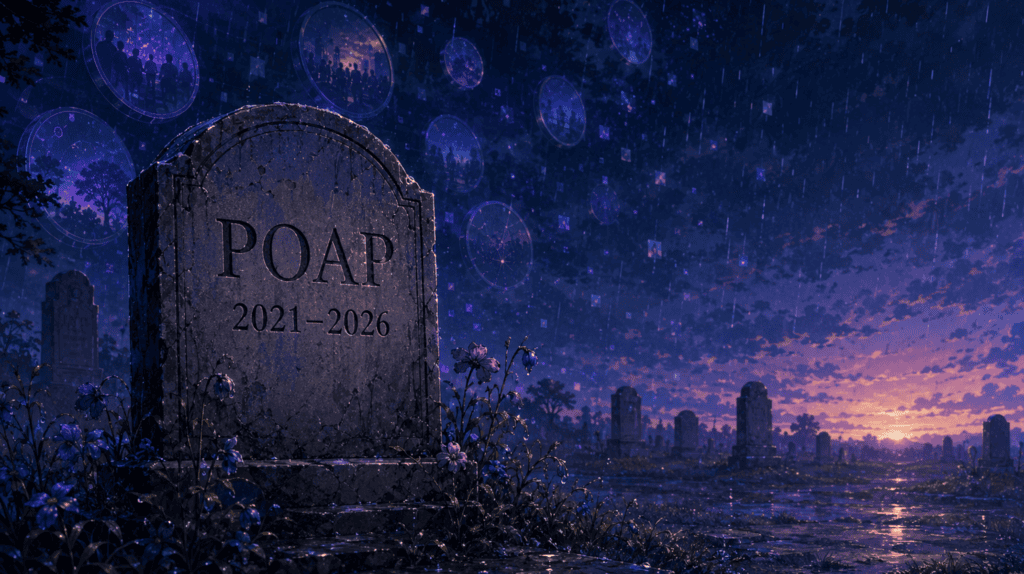
After 5+ years, we’re winding down POAP.
Over the years, we:
* minted millions of collectibles across hundreds of communities.
* did incredible collaborations with world-class organizations – Coinbase, Amex, WMG, Bayer, and a long tail of others, including countless in crypto.… pic.twitter.com/iFbRqs5qsI— isabel (@izonline) August 3, 2026
One of Web3’s most recognizable digital-collectible platforms is coming to an end—leaving behind millions of tokens, hundreds of communities, and an important lesson about building sustainable products without sacrificing their soul.
POAP, the platform that transformed attendance and participation into collectible digital memories, is winding down after more than five years.
The announcement was shared by POAP general manager and co-founder Isabel Gonzalez, who reflected on the platform’s accomplishments, its sustainability challenges, and the lessons its team learned while building through one of the most volatile eras in crypto.
During its run, POAP minted millions of digital collectibles across hundreds of communities. It also worked with major organizations including Coinbase, American Express, Warner Music Group, and Bayer, alongside countless crypto-native projects and events.
But POAP’s significance cannot be measured by mint totals or corporate partnerships alone.
For many people, POAP became a visual history of their journey through Web3—a wallet-sized scrapbook recording conferences attended, communities discovered, classes completed, hackathons survived, and friendships formed.
From Proof of Attendance to Proof of Experience
POAP stands for “Proof of Attendance Protocol.” The concept was elegantly simple: give someone a blockchain-based collectible proving they participated in a particular experience.
The earliest POAPs appeared at ETHDenver in 2019. The platform later moved to the xDai network, now known as Gnosis Chain, allowing organizers to distribute large numbers of collectibles without burdening participants with Ethereum mainnet gas fees.
That combination of simplicity, affordability, and emotional resonance helped POAP spread rapidly across Web3.
Communities used POAPs to recognize contributors. DAOs issued them during governance calls. Artists distributed them at exhibitions. Educators used them to commemorate completed courses, while conferences turned them into digital souvenirs.
POAP also gave mainstream organizations an accessible entry point into NFTs. Warner Music Group, for example, partnered with POAP in 2022 to help artists create digital mementos connected to concerts and album experiences. At the time, WMG described the technology as a bridge between digital identity and physical experience. Warner Music Group
At one major Devcon activation, POAP reportedly minted more than 8,000 collectibles during a single week. Its Airport Rally later expanded the idea beyond scheduled events, letting collectors claim location-based POAPs while traveling through more than 100 airports worldwide.
POAP had found something that many NFT projects missed: the collectible did not need a speculative price to have value. Its value came from the memory attached to it.
Why POAP Is Winding Down
According to Gonzalez, the decision reflects the difficulty of creating a sustainable crypto company without compromising the qualities that made its product meaningful.
Crypto’s boom-and-bust funding cycles frequently reward rapid expansion, aggressive monetization, and speculative activity. POAP, however, was built around low-cost or free collectibles whose primary purpose was commemoration rather than financial trading.
That created a fundamental business-model challenge. How do you monetize participation without making every interaction transactional? How do you charge communities without excluding the grassroots organizers responsible for the product’s growth? And how do you introduce commercial incentives without turning sentimental collectibles into another speculative asset?
POAP had already entered maintenance mode earlier in 2026, ending active development and stopping the onboarding of new issuers while continuing to support existing collections, integrations, and collector tools. The team said it wanted to explore more open infrastructure for digital collectibles. The Defiant
The latest announcement goes further, describing the company as winding down. It does not yet provide a detailed closure schedule or explain the long-term status of every application, API, and service.
Previously minted collectibles do not automatically disappear when the company behind an interface winds down. Their underlying blockchain records remain onchain. However, the tools people use to display, organize, issue, and interact with those assets may depend on infrastructure that requires ongoing maintenance.
That distinction is one of the defining promises—and persistent complications—of digital ownership.
Community Is More Valuable Than Most Companies Realize
One of Gonzalez’s biggest lessons from POAP is that customer communities remain among the most undervalued assets a company can build.
POAP grew because people cared enough to carry it into new spaces. Organizers created drops for small meetups, developers integrated POAP into applications, collectors shared their badges, and community members invented uses the original team could never have centrally planned.
This is what authentic distribution looks like.
The strongest communities do not merely consume a product. They interpret it, adapt it, teach others how to use it, and turn it into part of their identities.
POAP had brand ambassadors everywhere precisely because the product represented participation rather than promotion. Receiving a badge often felt less like entering a marketing funnel and more like being recognized for showing up.
That distinction matters—not only for Web3 companies, but for every brand trying to manufacture “community” through loyalty points, Discord servers, or engagement campaigns.
Community cannot simply be added as a growth channel. It must be earned through shared meaning.
Connection Was Always the Product
Crypto conversations have a habit of becoming trapped in technical architecture, token prices, and whichever narrative is driving the current cycle.
POAP was a reminder that the technology was never supposed to be the entire point.
The point was connection.
People collected POAPs because they represented moments: attending an early DAO meeting, meeting online friends in person, completing a hackathon, watching an artist perform, or joining a community before it became widely known.
The blockchain provided provenance and persistence, but the emotional value came from the human experience behind the token.
This remains one of the strongest long-term arguments for NFTs. The technology can create durable, interoperable records of culture, identity, participation, and belonging. Those applications may ultimately prove more important than purely speculative collectibles.
POAP did not need to promise financial returns. It gave people a way to say: I was there.
Brand Equity and Longevity Are the New Moats
POAP’s final lesson may be the most relevant in the age of artificial intelligence.
Software is becoming dramatically easier to build. AI-assisted development can compress months of product work into weeks—or even days. Distribution is also becoming increasingly automated, optimized, and engineered.
When features can be replicated quickly, technical functionality becomes a weaker competitive moat.
Trust becomes the differentiator.
Customers want confidence that the products, platforms, and digital assets they adopt will continue to exist. They want brands that can evolve with changing technology without abruptly abandoning the values that attracted their communities in the first place.
This is especially important in Web3, where users are often asked to invest more than money. They invest identity, reputation, creative work, community relationships, and years of participation.
Longevity cannot be guaranteed, but it can be cultivated through transparent governance, open standards, portable data, sustainable economics, and infrastructure that does not depend entirely on one company’s survival.
POAP’s Closure Is Not a Rejection of the Idea
It would be easy to interpret POAP’s wind-down as another failure from the NFT era. That reading would miss what the platform actually accomplished.
POAP proved that millions of people were willing to collect blockchain-based objects without requiring promises of profit. It showed that an NFT could function as a memory, credential, community signal, and cultural artifact. It helped normalize digital ownership for people who might never have purchased a traditional NFT.
The company struggled to convert that cultural utility into a sustainable business. That is a significant failure of the model—but it is not evidence that the underlying behavior was meaningless.
The next generation of builders can learn from both sides of the story.
Digital collectibles need open, durable infrastructure. They need business models aligned with their communities. They need portable experiences that can survive individual applications. Most importantly, they need to preserve the human connection that makes a digital object worth keeping.
POAP may be winding down as a company, but the millions of memories it helped record—and the product category it helped establish—will remain part of Web3’s history.
Sometimes the most important proof of attendance is proof that an idea mattered.
TL;DR
POAP is winding down after more than five years of creating blockchain-based memories for events, communities, brands, classrooms, and hackathons. The platform minted millions of collectibles and worked with organizations including Coinbase, American Express, Warner Music Group, and Bayer. Its closure highlights the difficulty of building a sustainable crypto business without compromising a community-first ethos. POAP’s enduring legacy is the demonstration that NFTs can hold emotional and cultural value without depending on speculation—and that community, connection, trust, and longevity remain the strongest moats in an increasingly automated world.