
Ask most people to name the biggest buyback story in crypto right now and they’ll say Hyperliquid, then guess Aerodrome or Pump for second.
According to DefiLlama’s own live rankings, two of the top three spots don’t belong to a governance token buying itself back at all, they belong to entire blockchains burning their own transaction fees.
I pulled DefiLlama’s Holders Revenue rankings expecting the usual suspects to sit at the top. What I found instead was a leaderboard where the real story isn’t which token wins, it’s how differently “buyback” can actually work depending on whether a team is pulling the trigger or the mechanism is baked into the chain itself.
How DefiLlama Defines Holder Revenue
DefiLlama’s Holders Revenue Rankings track something specific: actual dollars flowing to token or network holders through buyback-and-burn, fee-burning, or direct staker distributions, measured on-chain rather than self-reported. That definition doesn’t only capture DeFi protocols buying back a governance token, it also captures entire blockchains that burn a share of network fees, which returns value to holders in the same economic sense a buyback does, just without a treasury actively executing a purchase. That’s exactly what reshapes this podium.
Hyperliquid Holds A Commanding Lead
Hyperliquid sits at the top with $58.27 million in holder revenue over the past 30 days, and it isn’t particularly close to anything below it. The mechanism is aggressive by design: 99% of perpetual trading fees and up to 99% of spot trading fees route directly into the protocol’s Assistance Fund, which uses that revenue to buy HYPE on the open market. Hyperliquid alone generates more holder revenue in a month than the next two entries on this list combined.
Canton Takes Second As A Chain, Not A Token
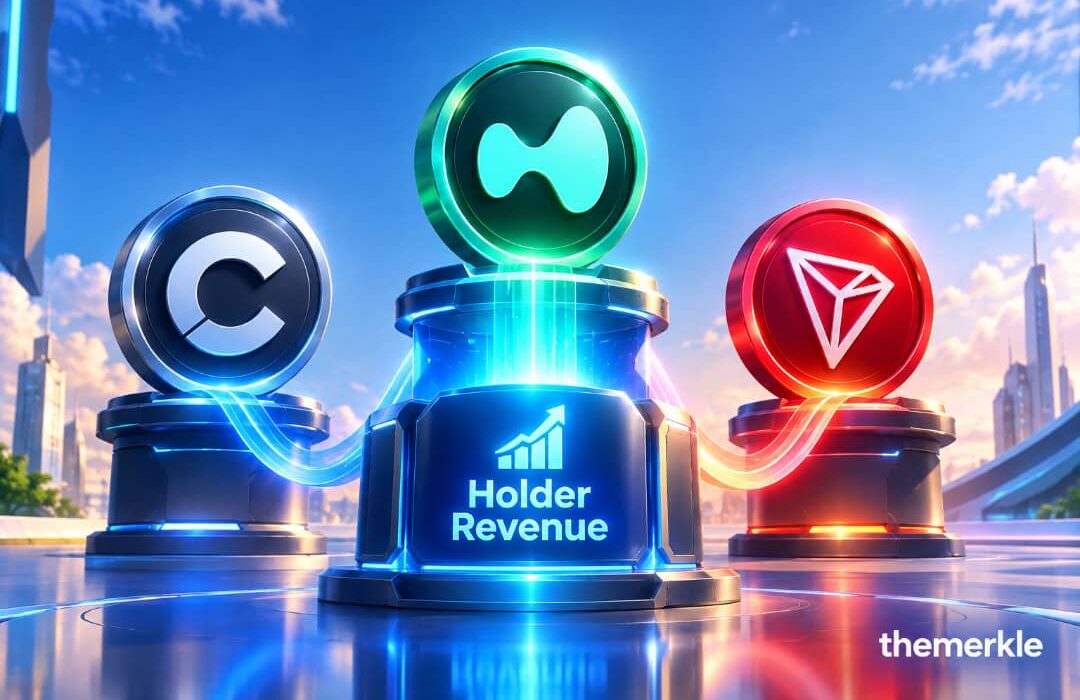
Canton, the privacy-focused institutional blockchain, currently sits second at $48.41 million in 30-day holder revenue, ahead of every DeFi protocol on the board. Canton’s mechanism isn’t a team executing discretionary market purchases; it’s structural. Every fee collected on the network, traffic purchases, preapproval burns, preapproval renewal burns, setup burns, dust expiry, holding fees, and sender-change fees, is burned outright as part of how the chain charges for its own usage. There’s no buyback decision being made day to day; the burn happens automatically with network activity. Whether that counts as a “buyback” in the traditional sense is a fair question, but by DefiLlama’s own definition of value returned to holders, it’s currently outperforming almost every DeFi protocol in crypto.

Tron Edges Out Pump For Third
Tron takes third at $24.06 million in 30-day holder revenue, edging out Pump’s $23.45 million by a narrow margin. Tron’s mechanism works the same structural way Canton’s does: a share of transaction fees is burned automatically as part of standard network activity, with no team making an active purchasing decision. That two of the top three spots on this board belong to base-layer fee burns rather than governance-token buybacks is the part of this ranking that rarely makes it into the usual “biggest buybacks in crypto” conversation, precisely because a chain burning gas fees doesn’t generate the same social-media attention a token buyback announcement does.
Where The Familiar Names Rank
Pump comes in just behind Tron at $23.45 million, making it the highest-ranked traditional governance token on the entire board once Hyperliquid is accounted for. The figure aggregates PUMP token buybacks sourced from on-chain burns across the platform’s bonding-curve trading, PumpSwap, and its trading terminal.
Below Pump, Uniswap sits at $16.13 million following its fee-switch activation, with Pons close behind at $15.83 million and Aerodrome at $14.36 million, meaning Aerodrome, despite its reputation as one of the most cited buyback tokens in DeFi, currently ranks sixth on this list. StonkFun follows at $11.1 million, consistent with its stated 60%-of-revenue buyback policy, while Sky, Aster, and Raydium each sit in the $4-5 million range for the same 30-day window.
The Real Takeaway On Buybacks
The lesson here isn’t that Hyperliquid, Canton, and Tron are the only three things worth paying attention to, it’s that the popular narrative around “biggest buybacks in crypto” tends to compress the field to whichever governance tokens get talked about most, while the on-chain data tells a slightly different story.
Two chain-level fee burns currently outrank Aerodrome, Uniswap, and every other named DeFi buyback token combined except Hyperliquid and Pump and that’s not a headline most people are chasing, because it doesn’t fit the usual framing of a team actively defending its token’s price. If you’re evaluating any of these assets specifically on the buyback thesis, the distinction between a discretionary token purchase and a structural network-level burn is worth knowing before assuming reputation and on-chain reality line up. Right now, for a meaningful chunk of this list, they don’t.
Disclosure: This is not trading or investment advice. Always do your research before buying any cryptocurrency or investing in any services.
Follow us on Twitter @themerklehash to stay updated with the latest Crypto, NFT, AI, Cybersecurity, and Metaverse news!