

I’ve been staring at a genuinely strange chart for the past few days: ZEC up roughly 150% in a month, ETF inflows accelerating by the day, whales quietly loading up in the background, and yet the people actually securing the network are earning less per unit of hardware than they were before any of this started.
It’s the kind of contradiction that only makes sense once you understand what a price rally actually does to a mining network, and once I worked through it, I realized this isn’t even unusual. It’s happened before, almost exactly this way.
The 150% Rally Nobody Saw Coming This Fast
ZEC has climbed roughly 150% over the past month, a move that’s turned Zcash from a quiet, mostly overlooked privacy coin into one of the more talked-about assets in crypto right now. For holders, that kind of move is straightforwardly great news, and it’s been amplified by genuine institutional demand rather than just speculative momentum. Grayscale’s Zcash ETF has pulled in approximately $34.4 million since August 25 alone, a meaningful inflow for a fund built around an asset that’s spent most of its history sitting on the margins of mainstream crypto conversation. I don’t think it’s a coincidence that the price move and the institutional inflows are happening at the same time, they’re almost certainly feeding each other.
But the part of this story that I think deserves more attention is what’s happening on the other side of the network, away from the price chart entirely.
Why Zcash’s Own Miners Are Earning Less Right Now
Here’s the detail that genuinely surprised me: even with ZEC trading dramatically higher, Zcash’s miners are making less money per unit of computing power than they were before the rally started. Zcash’s network hashrate jumped from roughly 25 GSol/s to above 30 GSol/s as the price surge pulled more hashpower onto the network, and that increase has been sharp enough to actually outpace the benefit of higher coin prices. According to current estimates, a top-end Z15 Pro miner is now earning approximately 3% less per megawatt-hour than it was in late August, despite ZEC being worth substantially more today than it was then.
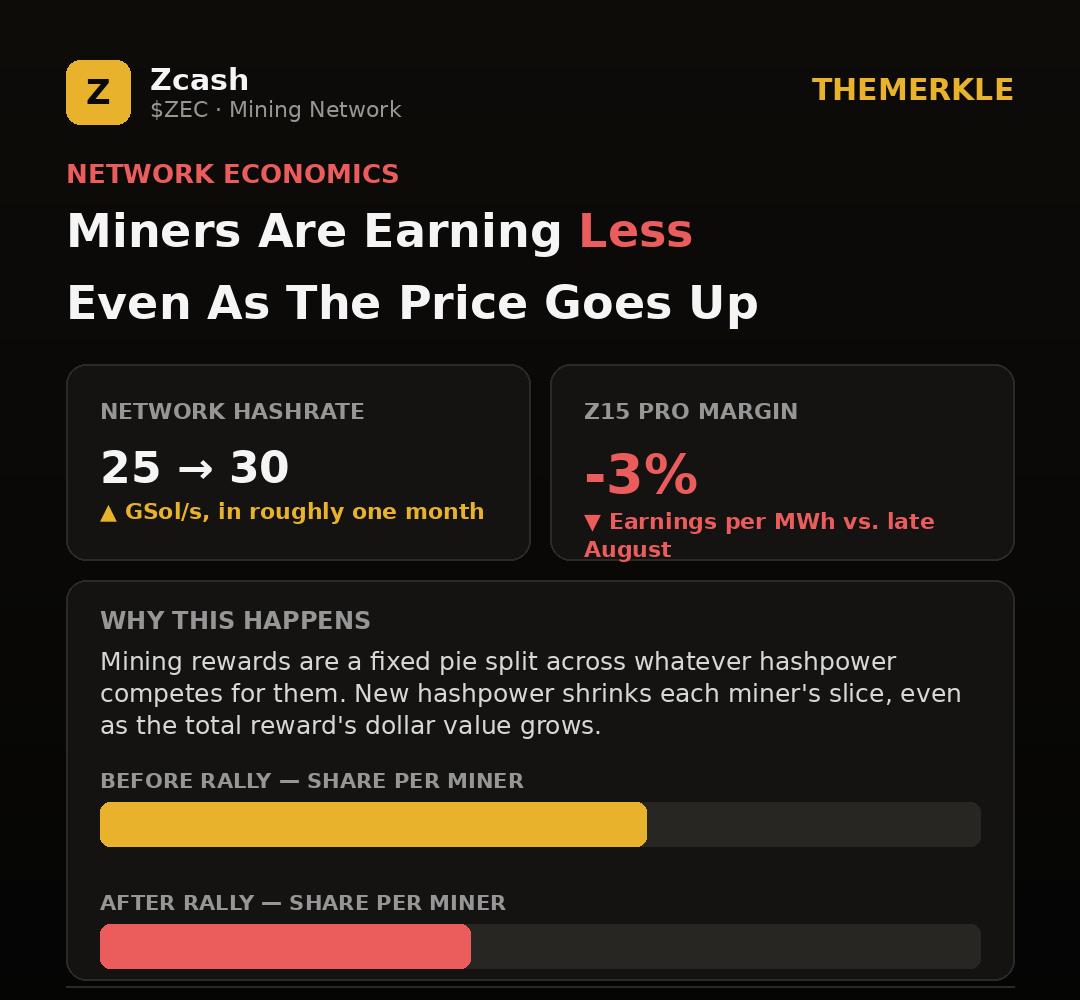
I think this is worth sitting with for a moment, because it runs against the intuitive assumption most people make about crypto mining. A higher coin price should mean more profit per machine, right? Not necessarily, and this is exactly the mechanism that explains why. When a coin’s price rallies hard, it attracts new miners and existing miners redirecting hardware toward it, chasing the higher expected reward. But mining rewards on most proof-of-work networks are fundamentally a fixed pie, a set number of coins issued per block, split across whatever hashpower happens to be competing for them at that moment. More hashpower competing for the same fixed reward means each individual miner’s share of that reward shrinks, even as the dollar value of the total reward pool grows. Price goes up, but so does competition for the reward, and the two forces can cancel each other out or worse.
Bitcoin Already Wrote This Exact Playbook
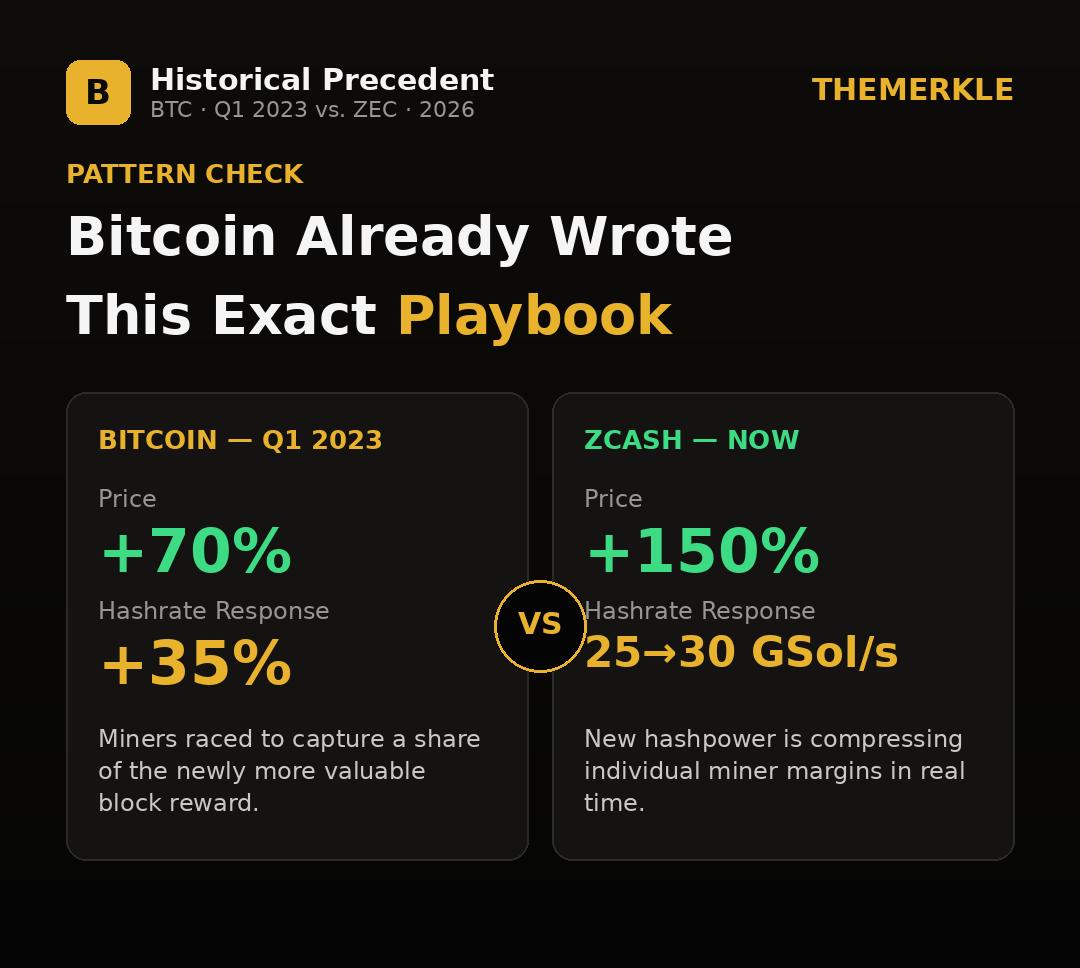
What makes this pattern genuinely credible rather than some Zcash-specific anomaly is that Bitcoin did almost precisely the same thing in the first quarter of 2023. During that stretch, BTC rallied roughly 70%, and its network hashrate climbed about 35% in response, as miners raced to capture a share of the newly more valuable block reward. The underlying mechanic is identical to what’s happening with Zcash right now: higher prices attract more hashpower, and that new hashpower compresses margins for everyone already mining, sometimes fast enough to offset a meaningful chunk of the price gain itself.
I find this comparison genuinely useful because it reframes what’s happening with Zcash right now from “something’s wrong with this rally” to “this is just what proof-of-work economics does, every time.” It’s a self-correcting mechanism built into how these networks function, price rallies pull in more security, that added security dilutes individual miner rewards, and the market eventually finds a new equilibrium once marginal miners either adapt their costs or drop off the network entirely.
The ETF Options Launch That Helped Fuel This Move
One of the clearer catalysts behind this week’s surge specifically is the NYSE’s decision to launch options trading on Grayscale’s Zcash ETF, ticker ZCSH. According to Grayscale’s own announcement, this marks the first time a regulated privacy-asset derivative has secured support on a major US exchange, a genuinely significant regulatory milestone given how cautiously US regulators have historically treated privacy-focused crypto assets.
The rollout gives institutional and retail participants the ability to execute call and put contracts against ZCSH, letting them either hedge existing exposure or take leveraged directional bets on ZEC’s price action through a regulated derivatives structure, something that simply wasn’t available for a privacy asset like Zcash before now. Grayscale was careful to note that ZCSH operates as an exchange-traded product not registered under the Investment Company Act of 1940, a structure that comes with more flexibility but is explicitly aimed at investors comfortable navigating heightened volatility, rather than a conservative, retail-first mutual fund wrapper.
Institutional Money Is Genuinely Piling In
The scale of capital now sitting behind this fund is hard to dismiss as noise. Grayscale confirmed that its Zcash fund has surpassed $500 million in assets under management, with ZCSH now holding over 550,000 ZEC.
Half a billion dollars in a fund dedicated entirely to a privacy coin is a genuinely notable milestone, and it’s a strong signal that institutional appetite for regulated privacy-asset exposure is real, not just theoretical.
That institutional demand is being echoed on-chain too. According to blockchain analytics platform Lookonchain, three wallets that may belong to the same whale have spent 3,700 ETH, worth roughly $9.23 million, along with 2 million USDC, to acquire 8,994 ZEC worth approximately $11.23 million, and the buying hasn’t stopped.
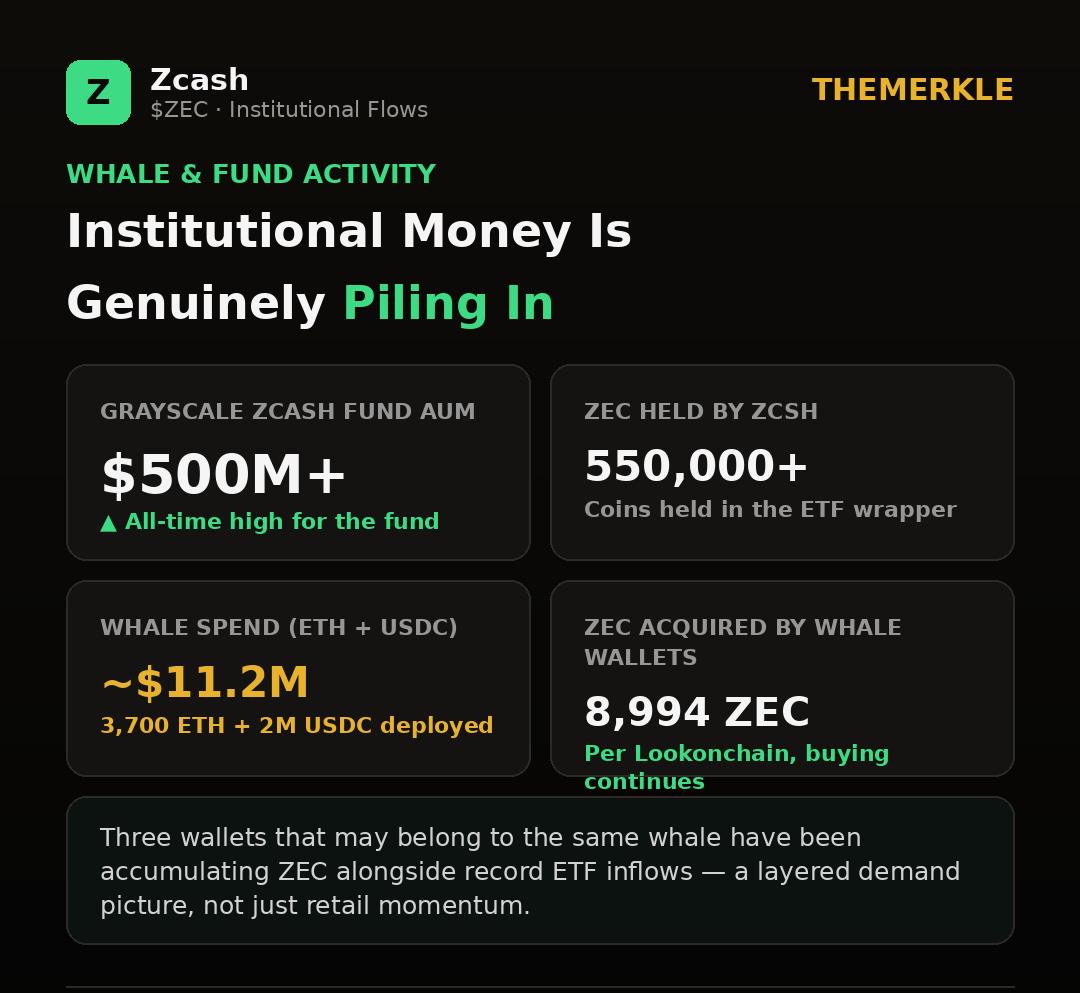
Whale accumulation on this scale, happening alongside record ETF inflows and a newly launched derivatives market, paints a picture of a rally with genuine, layered demand behind it, rather than one built purely on retail momentum.
What This Actually Means Going Forward
Putting all of this together, I think the honest read is that Zcash is experiencing two genuinely separate stories happening at once, and it’s worth not conflating them. On the investment side, this rally looks structurally sound: real institutional inflows, a newly regulated derivatives market, and visible whale accumulation all pointing toward sustained demand rather than a fleeting pump. On the mining side, the network is simply behaving the way proof-of-work networks always behave when prices move this fast, hashrate is chasing the reward, and individual miner margins are compressing as a direct consequence, regardless of how good the price action looks on a chart.
Neither of those two stories necessarily reverses the other. Miners adjusting to thinner margins is a normal, expected part of this cycle, not a sign that something is broken with Zcash itself. If anything, watching the hashrate climb this fast is itself a form of validation, it means enough people believe ZEC’s higher price is durable enough to be worth competing for. Whether that hashrate keeps climbing, and whether miner margins keep compressing alongside it, is probably the more interesting thing to watch next, now that the ETF and options infrastructure behind this rally is fully in place.
Disclosure: This is not trading or investment advice. Always do your research before buying any cryptocurrency or investing in any services.
Follow us on Twitter @themerklehash to stay updated with the latest Crypto, NFT, AI, Cybersecurity, and Metaverse news!